
You run a competitor analysis. You find thirty sites linking to your rivals. None linking to you. Good data. Now what?
Traditional answer: Export those domains to a spreadsheet. Research each one manually. Find contact pages. Write personalized emails. Wait for replies. Handle rejections. Track follow-ups. Maybe, six months later, you secure a few links.
That timeline doesn’t work anymore.
The platforms below integrate competitor analysis with actual link acquisition. You find the gap. You buy the link. You close the distance between you and the sites outranking you. No spreadsheets required.
Here are four platforms built specifically for this workflow.
How These Platforms Close the Gap
The table below shows four different methods for turning competitor data into purchased links.
| Platform | Gap Analysis Method | From Analysis to Purchase | Price Range | Best For |
| INSERT.LINK | Page-level keyword search against competitor content | Search competitor topics, find live pages accepting links | $10–$500+ per link | Teams wanting to target specific competitor pages |
| Linkhouse | Dedicated Backlink Gap Tool with competitor comparison | Enter competitors, get list of their referring domains available for purchase | $9.99–$900+ per link | Data-driven teams wanting full competitor profile analysis |
| MeUp | Competitor Link Gap Tool with project-based tracking | Add competitors, scan completes in minutes, filter available domains | Copywriting from $25; placements under $200 available | Agencies managing multiple client competitor sets |
| PressWhizz | Keyword-based competitor link discovery | Search competitor brand terms, find exact pages mentioning them | Average $130 per link | Buyers who need to see exact page context before purchasing |
Each platform above integrates competitor analysis differently. Some scan entire backlink profiles. Others search based on keywords. The descriptions below show exactly how you move from spotting a gap to filling it.
1. INSERT.LINK
Close gaps at the page level.
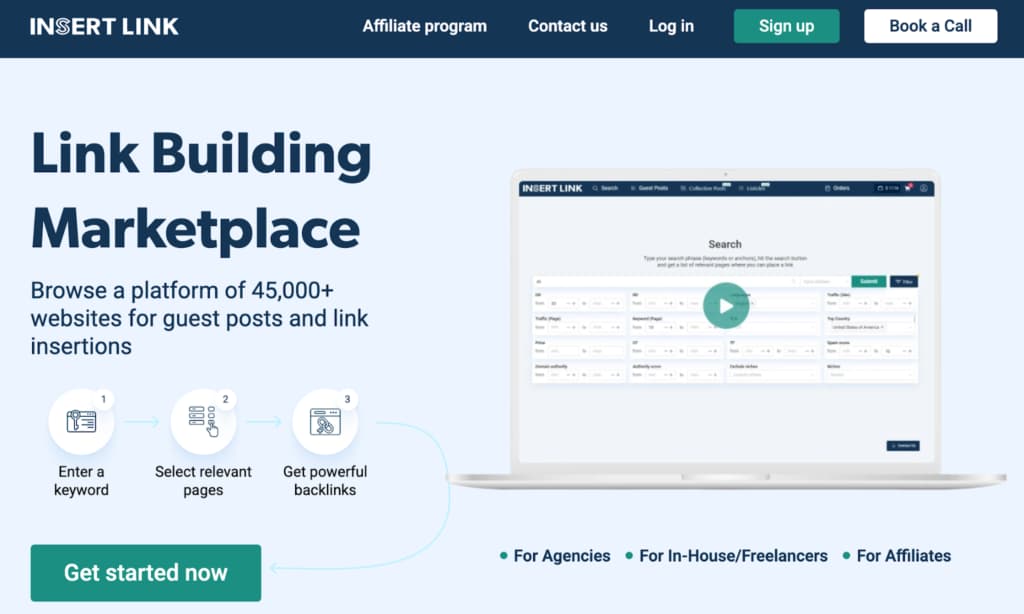
INSERT.LINK is a link building marketplace that approaches competitor analysis differently. Most gap tools show you competitor domains. INSERT.LINK shows you competitor pages. You enter a keyword your rival ranks for. The platform returns specific articles where you could insert a link.
You see domain rating, traffic numbers, and article previews before paying. That page-level view matters because context matters. A link on the right page of a mediocre site often outperforms a link on the wrong page of a high-DR domain.
The database holds more than 45,000 websites across fifteen niches. Every site gets reviewed before listing. Metrics pull from multiple sources so you’re not trusting one data point.
Pricing starts around $10 for lower-authority insertions. Guest posts begin near $40. A DR40-50 site with steady traffic typically runs $80 to $170.
Turnaround averages two to three days for insertions. Three to seven for guest posts. Payment is released only after you approve the completed work.
- What makes this work for gap closing: You search based on competitor content, not just competitor domains. If they rank because of specific pages, you can target those exact pages.
2. Linkhouse
Dedicated gap tool with full competitor profiling.
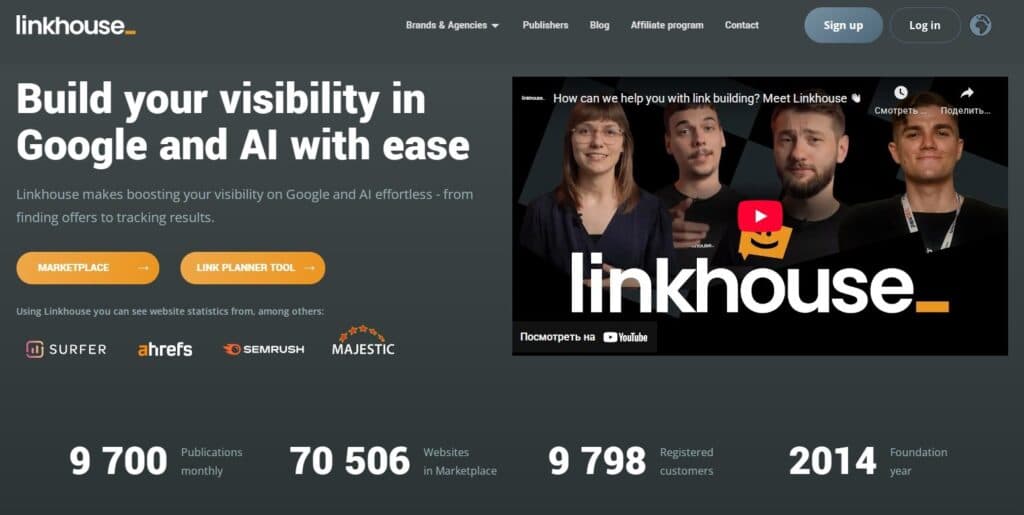
Linkhouse built their Backlink Gap Tool specifically for this use case. You enter your domain and a keyword. The tool pulls competitor data from Ahrefs, Semrush, and Google simultaneously.
You select which competitors to analyze. The tool generates a complete list of portals where those competitors have backlinks. Every domain on that list is available for purchase directly through Linkhouse.
Filters let you narrow by competitor count, domain authority, and relevancy. You can focus on domains linking to multiple competitors for maximum impact. Each listing shows key metrics so you know what you’re getting.
The platform has operated since 2014. Their marketplace holds more than 75,000 domains across 25 languages. European coverage is particularly strong, with good selections in German, French, Spanish, and Italian markets.
Pricing starts around $9.99 for link placements. Copywriting from $29. Publisher listings show detailed metrics before purchase.
- What makes this work for gap closing: The tool does the competitor analysis for you. You don’t export lists and cross-check against inventory. The gap analysis and the marketplace are the same system.
3. MeUp
Project-based gap tracking for multiple competitors.
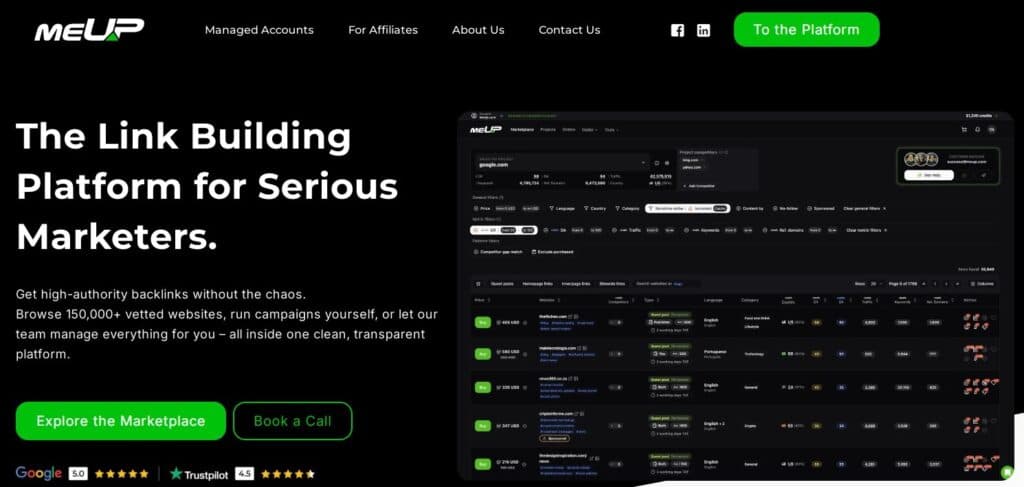
MeUp’s Competitor Link Gap Tool lets you create projects for each website you manage. Enter your domain. Add competitor domains. The tool runs a full backlink scan comparing their profiles against MeUp’s marketplace inventory.
The scan takes about five minutes. Once complete, a filter shows you every marketplace link that has a backlink to your competitors. You see exactly what you’re missing.
The platform launched in 2023 and has grown to more than 150,000 placements. Every publisher shows detailed metrics, including organic traffic, traffic trends, Semrush Authority Score, and traffic share by country.
Pricing varies by publisher. Copywriting starts from $25. You can filter and find relevant placements under $200. European coverage is particularly strong, though the US and UK markets are well represented.
The payment model removes risk. You don’t pay until the link goes live. Publishers deliver first. You inspect the work. Then payment releases.
- What makes this work for gap closing: You can track multiple competitors per project and revisit gaps over time. The filter shows only domains available for immediate purchase.
4. PressWhizz
Find competitor links by keyword, not just domain.
PressWhizz takes a different angle. Instead of comparing full backlink profiles, you search for competitor brand terms. Type a competitor name into the search bar. The platform returns every site mentioning them.
You see domain authority, organic traffic, spam score, and the exact page where your competitor appears. You can then choose to build a niche edit on that same page, target a different page on the same site, or order a fresh guest post.
The database includes 37,000+ curated sites across 90+ countries. Average price per link runs $131.61. A search for UK domains with DR40+ and decent traffic shows opportunities around $80.
Turnaround averages 18 hours. Fastest in this list. They back placements with a 12-month replacement guarantee. If the link disappears, they replace it.
Every publisher gets vetted before listing. You see full URL previews before purchase, so you know exactly where your link will land.
- What makes this work for gap closing: You discover competitor links through keyword searches, then immediately see pricing and availability. No cross-referencing required.
What Gap Closing Looks Like on These Platforms
The old method took days. Export competitor domains. Run them through Ahrefs. Filter for relevance. Research each site. Find contacts. Send emails. Track replies. Follow up. Negotiate. Finally, maybe, secure a link.
The new method takes minutes.
On Linkhouse, you enter your domain and a keyword. The tool shows you every competitor’s backlink available for purchase. You check a box. You complete checkout. The gap closes.
On MeUp, you create a project, add competitors, wait five minutes for the scan, and filter for available domains. You buy what fits.
On PressWhizz, you search competitor brand names, find pages mentioning them, and order placements on those exact domains.
On INSERT.LINK, you search keywords your competitors rank for, and find specific pages accepting links.
All four replace manual research with direct acquisition. You’re not finding sites to pitch. You’re finding sites to purchase.
Conclusion: Which Gap Tool Fits Your Workflow
Different teams analyze competitors differently.
If you want to target specific pages your competitors rank from, INSERT.LINK gives you page-level search. You find the exact content driving their traffic and add your link nearby.
If you want a full backlink profile comparison with purchase built in, Linkhouse’s dedicated gap tool shows you every competitor domain available in their marketplace. The analysis and acquisition happen in one place.
If you manage multiple clients or projects, MeUp’s project-based tracking lets you maintain separate competitor sets. Each client gets their own gap analysis.
If you prefer keyword-based discovery, PressWhizz lets you search competitor brand terms and see every site mentioning them. You find opportunities through content context, not just domain lists.
Test one. Run a competitor through their gap tool. See what comes back. Check the available domains. Look at the metrics. Compare against what your competitors actually have.
The platform that shows you real gaps with real inventory is the one worth using.